
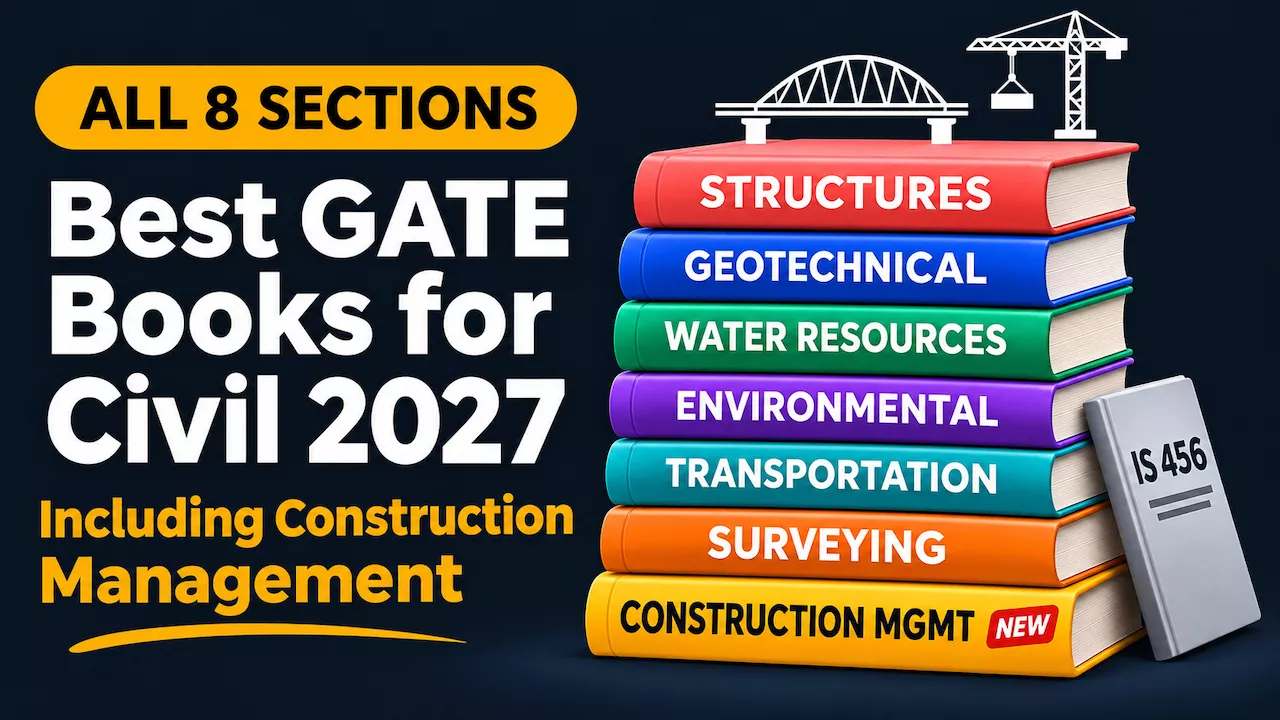
The GATE 2027 Civil syllabus has 8 sections now, not 7. IIT Madras added a full new section, Construction Materials and Management, and almost every list of the Best GATE Books for Civil online was written before that change. This guide covers all 8 sections, gives the new section its own book list, and adds something most lists forget: the IS and IRC codes you need beside your design books.
The Best GATE Books for Civil below are listed in the order of the official CE syllabus. Where useful, you will see the average marks each section carried from 2019 to 2025, taken from our most scoring subject for GATE Civil 2027 analysis.
Best GATE Books for Civil: Mathematics and Aptitude
Engineering Mathematics carried about 12.4 marks on average and General Aptitude about 14.9, so these 2 of the Best GATE Books for Civil are worth almost as much as Structural Engineering.
- Main book: Higher Engineering Mathematics by B.S. Grewal, for linear algebra, calculus, ODEs and PDEs, probability with linear regression, and numerical methods.
- Backup: Advanced Engineering Mathematics by Erwin Kreyszig, if a concept needs a deeper explanation.
- Aptitude: Quantitative Aptitude for Competitive Examinations by R.S. Aggarwal, or our free General Aptitude notes PDF, which covers all 4 GA areas in 19 pages.
Some lists suggest a discrete mathematics book for Civil. You do not need it: discrete maths is a CSE topic and is not in the CE syllabus.
Best GATE Books for Civil: Structural Engineering (About 17.4 Marks)
This is the highest-scoring section, and the only one where the Best GATE Books for Civil include both analysis books and design books.
- Solid mechanics: Strength of Materials by R.K. Bansal or S.S. Rattan, for bending, shear, torsion, Mohr’s circle and column buckling.
- Structural analysis: Structural Analysis by R.C. Hibbeler, with Theory of Structures by S. Ramamrutham for Indian-style numericals. Cover force and displacement methods, slope-deflection, moment distribution, influence lines, stiffness matrix, arches and cables.
- Concrete structures: Reinforced Concrete Design by S. Unnikrishna Pillai and Devdas Menon. Code: IS 456:2000.
- Steel structures: Design of Steel Structures by S.K. Duggal or N. Subramanian. Code: IS 800:2007.
- New in 2027: Castigliano’s second theorem, and design and detailing of isolated footings. Hibbeler covers Castigliano’s theorem in its energy methods part, and the footing design chapter of any RCC book covers the second.
Best GATE Books for Civil: Geotechnical Engineering (About 14.9 Marks)
Geotechnical questions are mostly numerical, so judge the Best GATE Books for Civil in this section by their solved examples, not by their size.
- Main book: Soil Mechanics and Foundation Engineering by K.R. Arora, which is easy to read and full of solved examples.
- Backup: Basic and Applied Soil Mechanics by Gopal Ranjan and A.S.R. Rao, or Geotechnical Engineering by C. Venkatramaiah.
- Read for GATE: phase relations, classification, permeability and flow nets, effective stress, consolidation, shear strength and stress paths, earth pressure, slope stability with Bishop’s method, Boussinesq stress, bearing capacity, settlement, and pile foundations.
- New in 2027: sheet piles and ground improvement techniques. Read these chapters even if your old notes skipped them.
Best GATE Books for Civil: Water Resources Engineering (About 13.1 Marks)
Water Resources is really 4 subjects, so its share of the Best GATE Books for Civil is a small shelf rather than 1 book:
- Fluid mechanics: A Textbook of Fluid Mechanics and Hydraulic Machines by R.K. Bansal, or Hydraulics and Fluid Mechanics by Modi and Seth.
- Open channel flow: Flow in Open Channels by K. Subramanya, for specific energy, hydraulic jump and gradually varied flow.
- Hydrology: Engineering Hydrology by K. Subramanya, for hydrographs, flood routing and well hydraulics.
- Irrigation: Irrigation Engineering and Hydraulic Structures by S.K. Garg, for duty and delta, canals, weirs on permeable foundations, dams and spillways.
- New in 2027: mobile channels, rapidly varied flow, surface runoff models, earthen dams, seepage through dams, river training structures and well irrigation. Subramanya and Garg cover most of these.
Best GATE Books for Civil: Environmental Engineering (About 9.9 Marks)
Environmental Engineering is formula-based and among the easier sections to score in, so 1 good set from the Best GATE Books for Civil is enough here.
- Main books: Water Supply Engineering and Sewage Disposal and Air Pollution Engineering by S.K. Garg, the 2 volumes most Indian students use.
- Backup: Environmental Engineering by Peavy, Rowe and Tchobanoglous, which is especially clear on solid waste.
- Read for GATE: water quality and treatment, distribution, sewer design, primary to tertiary treatment, sludge, air pollution and the air quality index, and municipal solid waste.
- New in 2027: basics of landfill design and operation. Noise pollution, which many old lists and notes still include, is not in the CE syllabus.
Best GATE Books for Civil: Transportation Engineering (About 8.2 Marks)
- Main book: Highway Engineering by S.K. Khanna, C.E.G. Justo and A. Veeraragavan.
- Traffic and planning: Traffic Engineering and Transport Planning by L.R. Kadiyali, for flow-speed-density, Webster’s signal design, level of service and the 4-step travel demand model, which is new in 2027.
- Codes: IRC:37 for flexible pavements, IRC:58 for rigid pavements, and IRC:73 for geometric design of rural highways.
- Rail and airports: GATE asks only railway speed and cant, and runway length with its corrections plus taxiway design, so 1 chapter from any transportation text is enough.
Best GATE Books for Civil: Geomatics Engineering (About 6.8 Marks)
- Main book: Surveying, Volumes 1 and 2, by B.C. Punmia, Ashok Jain and Arun Jain.
- Read for GATE: levelling, traversing, triangulation, total station, errors and their adjustment, and photogrammetry with parallax equations.
- New in 2027: GNSS surveying, cartography, map projections, digital photogrammetry and camera calibration. For GNSS and map projections, the NPTEL surveying courses by IIT faculty are a good free source.
- Removed: remote sensing and GIS are no longer in the syllabus, so you can skip those chapters.
Best GATE Books for Civil: Construction Materials and Management (New in 2027)
This is the section most lists of the Best GATE Books for Civil leave out, because it did not exist as a separate section before 2027. It has 2 halves, and each needs its own source.
| Topic in the 2027 syllabus | Book (author) | Code or note |
|---|---|---|
| Cement: composition, hydration, microstructure, admixtures | Concrete Technology (M.S. Shetty) | Properties of Concrete (A.M. Neville) for deeper reading |
| Concrete: constituents, mix design, short and long-term properties | Concrete Technology (M.S. Shetty) | IS 10262:2019 for mix design |
| Steel: composition, properties and behaviour | The materials chapter of your steel design book | IS 800:2007 for grades and properties |
| Estimation and costing: long wall short wall, centre line, rate analysis | Estimating and Costing in Civil Engineering (B.N. Dutta) | Practise 1 small building estimate by hand |
| Project planning: AOA and AON networks, PERT and CPM, updating | Project Planning and Control with PERT and CPM (B.C. Punmia and K.K. Khandelwal) | Solve float and crashing numericals |
| Construction equipment and types of contracts | Construction Planning, Equipment, and Methods (Peurifoy and others) | Read only earthwork, concreting, hoisting and transport equipment |
No past GATE paper has a full section on these topics, so there are few previous year questions to learn from. Expect short conceptual MCQs on cement and concrete, and numericals on PERT, CPM and quantity estimation. Our GATE Civil Engineering notes explain how to fill this gap alongside the downloadable notes.
Chapters in Old Civil Books You Can Skip for 2027
The same 2027 revision also removed topics. If your copy of the Best GATE Books for Civil has these chapters, leave them out:
- Prestressed concrete (removed from Concrete Structures).
- Plate girders (removed from Steel Structures).
- Remote sensing and GIS (removed from Geomatics).
- Dynamic pile formulae (only static formulae are named now).
- Free vibration of single degree of freedom systems (no longer in the CE syllabus).
- Noise pollution (not in the Environmental section).
The full list of what was added and removed is in our GATE Civil Engineering syllabus 2027 guide.
How to Use the Best GATE Books for Civil in the Time Left
With GATE 2027 starting on 6 February, read selectively. Start with Structural and Geotechnical Engineering, which together carry about 32 marks, and keep your IS 456 and IS 800 copies open while you solve design questions, because GATE asks clause-based values such as minimum steel and effective length. Older editions are fine for almost all the Best GATE Books for Civil here, except that RCC and steel books should follow the current IS codes.
After each chapter, solve previous year questions on it, then follow the section order in our GATE Civil 2027 4 months study plan. To set your target, remember that the General cutoff was 28.3 in 2024, 29.2 in 2025 and 28.7 in 2026, as covered in our GATE Civil previous year cutoff analysis.
FAQs on Best GATE Books for Civil
Which are the best GATE books for Civil?
The Best GATE Books for Civil are Grewal for maths, Hibbeler and Ramamrutham for structural analysis, Pillai and Menon for RCC, Duggal for steel, K.R. Arora for geotechnical, Subramanya and S.K. Garg for water resources, S.K. Garg for environmental, Khanna and Justo for highways, Punmia for surveying and M.S. Shetty for concrete technology.
Which book is best for Construction Materials and Management in GATE 2027?
Use Concrete Technology by M.S. Shetty for cement and concrete, Estimating and Costing by B.N. Dutta for quantity estimation, Punmia and Khandelwal for PERT and CPM, and Peurifoy for construction equipment.
Do I need IS codes for GATE Civil?
Yes. Keep IS 456 for RCC, IS 800 for steel and IS 10262 for concrete mix design, plus IRC 37 and IRC 58 for pavement design. GATE asks clause-based values from these codes.
Which chapters can I skip in GATE Civil books for 2027?
In the Best GATE Books for Civil, skip prestressed concrete, plate girders, remote sensing and GIS, dynamic pile formulae, single degree of freedom vibration and noise pollution, because the 2027 CE syllabus no longer includes them.
Is discrete mathematics needed for GATE Civil?
No. Discrete mathematics is part of the CSE syllabus. The Civil maths syllabus covers linear algebra, calculus, ODE and PDE, probability and statistics, and numerical methods.
Which is the best book for geotechnical engineering for GATE?
Soil Mechanics and Foundation Engineering by K.R. Arora is the easiest to study from, with Gopal Ranjan and Rao as a backup. Make sure you also read sheet piles and ground improvement, which are named in the 2027 syllabus.
Are old editions fine for GATE Civil books?
Yes, for most subjects. For RCC and steel design, use editions based on the current codes, IS 456 2000 and IS 800 2007.