
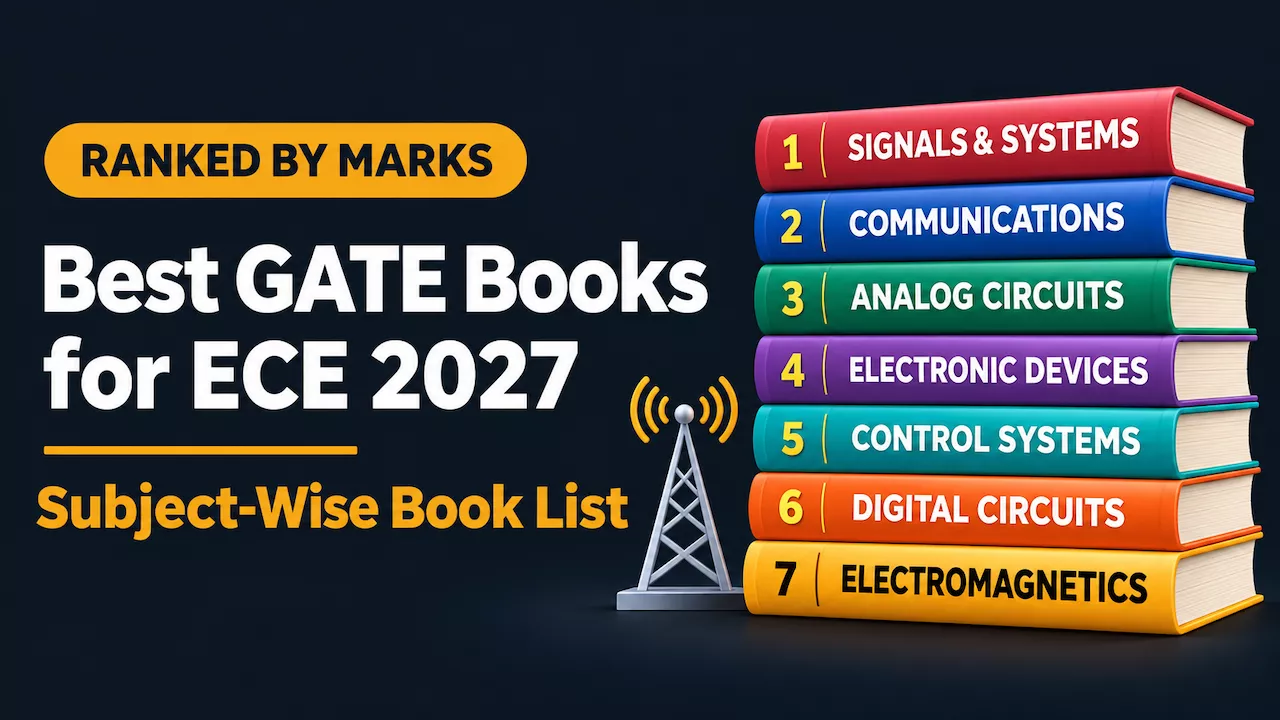
Most lists of the Best GATE Books for ECE give you 50 titles in syllabus order and leave you to guess where to start. This one is ranked by marks. The section that usually carries the most marks in the EC paper comes first, with the 2 books that cover it best, and the lowest-weightage section comes last. Read the Best GATE Books for ECE in this order and your first few months of study go to the topics that decide most of your score.
Every one of the Best GATE Books for ECE below is matched to the official GATE 2027 EC syllabus released by IIT Madras, including the new 2027 topics such as FIR and IIR filter design, the PID controller and MOSFET scaling. The marks ranges are estimates from recent papers, as explained in our GATE ECE syllabus 2027 guide.
Best GATE Books for ECE, Ranked From Highest to Lowest Marks
For each section in this list of the Best GATE Books for ECE, you get a learn book to understand the theory and a practice book or backup to drill numericals, plus what the 2027 syllabus means for that section.
#1 Best GATE Books for ECE: Networks, Signals and Systems (13 to 19 Marks)
This is the heaviest section of the EC paper, so it deserves the strongest of the Best GATE Books for ECE. For networks, learn from Fundamentals of Electric Circuits by Charles Alexander and Matthew Sadiku, and practise with Network Analysis by M.E. Van Valkenburg. For signals, the standard text is Signals and Systems by Alan Oppenheim, Alan Willsky and S. Hamid Nawab, and Schaum’s Outline of Signals and Systems by Hwei Hsu gives you hundreds of solved problems.
2027 note: FIR and IIR filter design is now named in the syllabus, which is the largest addition to the paper. Read the filter design chapters of Digital Signal Processing by John Proakis and Dimitris Manolakis for the window method and the bilinear transform. You do not need the rest of that book.
#2 Best GATE Books for ECE: General Aptitude (15 Marks, Fixed)
General Aptitude is the same 15 marks in every GATE paper, and it is the easiest section to score in. R.S. Aggarwal’s Quantitative Aptitude for Competitive Examinations covers the numerical part, and A Modern Approach to Verbal and Non-Verbal Reasoning by the same author covers the rest. Objective General English by S.P. Bakshi helps if grammar questions cost you marks.
You do not need a thick CAT-level book for GATE aptitude. Our free General Aptitude notes PDF covers all 4 GA areas in 19 pages with a practice set.
#3 Best GATE Books for ECE: Communications (10 to 14 Marks)
The learn book is Modern Digital and Analog Communication Systems by B.P. Lathi and Zhi Ding, which explains modulation, noise and digital communication in a clear order. Keep Communication Systems by Simon Haykin as the backup, and use Principles of Communication Systems by Taub and Schilling for random processes and noise if Lathi feels short there.
2027 note: source coding now sits next to entropy and channel capacity in the Information Theory line. Practise Huffman and Shannon-Fano coding, code length and efficiency from the information theory chapter of Lathi or Haykin.
#4 Best GATE Books for ECE: Engineering Mathematics (9 to 14 Marks)
Higher Engineering Mathematics by B.S. Grewal is the practice book most GATE students use, because it has a large number of solved examples at the right level. For concepts, Advanced Engineering Mathematics by Erwin Kreyszig is the standard text. Cover linear algebra, calculus, differential equations, complex analysis, vector analysis and probability.
2027 note: correlation and regression analysis is new in the statistics part. Grewal’s statistics chapter is enough for these short questions. First order nonlinear differential equations are no longer listed, so you can skip that topic.
#5 Best GATE Books for ECE: Analog Circuits (8 to 13 Marks)
Microelectronic Circuits by Adel Sedra and Kenneth Smith is the main book for diode, BJT and MOSFET amplifiers, feedback and op-amps. If Sedra and Smith feels heavy, Electronic Devices and Circuit Theory by Robert Boylestad and Louis Nashelsky explains the same circuits in simpler steps. For op-amp circuits such as active filters, Schmitt triggers and oscillators, Op-Amps and Linear Integrated Circuits by Ramakant Gayakwad is a popular extra.
2027 note: dominant-pole (Miller) compensation and phase margin are now named under op-amps. Read the frequency response and compensation parts of Sedra and Smith, and link them with Bode plots from Control Systems.
#6 Best GATE Books for ECE: Electronic Devices (7 to 12 Marks)
Solid State Electronic Devices by Ben Streetman and Sanjay Banerjee is the classic learn book for semiconductors, carrier transport, the P-N junction, BJT and MOSFET. Semiconductor Physics and Devices by Donald Neamen is the backup, with more worked examples.
2027 note: the syllabus now opens with formation of energy bands in solids and adds scaling in MOSFETs. Both are standard topics in these 2 books. Focus on how constant-field scaling and constant-voltage scaling change delay, power and current.
#7 Best GATE Books for ECE: Control Systems (7 to 10 Marks)
Control Systems Engineering by I.J. Nagrath and M. Gopal is the most used learn book in India, and it covers transfer functions, time response, stability, root locus, Bode plots and state variables. Modern Control Engineering by Katsuhiko Ogata is the best backup for numericals.
2027 note: lag, lead and lag-lead compensation is now just compensators, and the PID controller is new. Ogata explains PID control in detail, so read that part for the effect of P, I and D action on steady-state error and overshoot.
#8 Best GATE Books for ECE: Digital Circuits (7 to 9 Marks)
Digital Design by M. Morris Mano and Michael Ciletti covers number systems, Boolean algebra, combinational and sequential circuits. Modern Digital Electronics by R.P. Jain is the backup, and it also covers data converters and semiconductor memories, which are both in the syllabus.
The EC syllabus also has a short computer organization part: machine instructions, addressing modes, the ALU, data-path, control unit and instruction pipelining. Computer System Architecture by M. Morris Mano covers this at the right depth. Microprocessor programming is not in the 2027 EC syllabus, so you do not need an 8085 book.
#9 Best GATE Books for ECE: Electromagnetics (6 to 11 Marks)
Elements of Electromagnetics by Matthew Sadiku is the easiest learn book for vector analysis, Maxwell’s equations, plane waves, transmission lines and waveguides. Engineering Electromagnetics by William Hayt and John Buck is the backup. For transmission lines and the Smith chart, many students also use Networks, Lines and Fields by J.D. Ryder, and the free NPTEL lectures by Prof. R.K. Shevgaonkar of IIT Bombay are a strong video option.
The 2027 syllabus asks only about dipole and monopole antennas, linear antenna arrays and light propagation in optical fibres. The antenna chapter of Sadiku is enough, so a full antenna book is not needed for GATE.
Best GATE Books for ECE Recap Table
Here are the Best GATE Books for ECE in 1 place, so you can buy or borrow books in the same order you will study them.
| Rank | Section (usual marks) | Learn book | Practice or backup book |
|---|---|---|---|
| 1 | Networks, Signals and Systems (13 to 19) | Alexander and Sadiku; Oppenheim and Willsky | Van Valkenburg; Schaum’s (Hwei Hsu) |
| 2 | General Aptitude (15) | R.S. Aggarwal, Quantitative Aptitude | R.S. Aggarwal, Verbal and Non-Verbal Reasoning |
| 3 | Communications (10 to 14) | B.P. Lathi and Zhi Ding | Simon Haykin; Taub and Schilling |
| 4 | Engineering Mathematics (9 to 14) | Erwin Kreyszig | B.S. Grewal |
| 5 | Analog Circuits (8 to 13) | Sedra and Smith | Boylestad and Nashelsky; Gayakwad |
| 6 | Electronic Devices (7 to 12) | Streetman and Banerjee | Donald Neamen |
| 7 | Control Systems (7 to 10) | Nagrath and Gopal | Katsuhiko Ogata |
| 8 | Digital Circuits (7 to 9) | Morris Mano and Ciletti | R.P. Jain; Mano for computer organization |
| 9 | Electromagnetics (6 to 11) | Matthew Sadiku | Hayt and Buck; J.D. Ryder |
Books on Older Lists You Can Skip for GATE ECE 2027
Many lists of the Best GATE Books for ECE online were made for older syllabi. These titles are good books, but they are not the best use of your time for the 2027 paper:
| Book often listed | Why you can skip it for 2027 |
|---|---|
| Microprocessor books on the 8085 (Ramesh Gaonkar) | Microprocessor programming is not in the 2027 EC syllabus; only basic computer organization is |
| Antenna Theory (Constantine Balanis) | GATE asks only dipole, monopole and linear array basics, which Sadiku covers |
| Physics of Semiconductor Devices (S.M. Sze) | A research-level reference; Streetman or Neamen is enough for GATE |
| Pulse and Digital Circuits (Millman and Taub) | Clipping and clamping are covered well in Boylestad and Nashelsky |
| CAT-level aptitude books | GATE aptitude is easier; R.S. Aggarwal and previous year GA questions are enough |
How Many of the Best GATE Books for ECE Do You Really Need?
You need about 10 to 12 of the Best GATE Books for ECE, not 50. That means 1 learn book per section, a maths practice book and a source of previous year questions. A topic-wise previous year solved papers book for GATE EC, from any well-known publisher, is worth buying, because GATE repeats question styles more than it repeats questions.
Pair the Best GATE Books for ECE with free resources. Our GATE ECE notes are good for the last 30 days of revision, when nobody can reread a full textbook. And once a section is done, test it in the official exam window with our free GATE ECE mock test series.
How to Read the Best GATE Books for ECE in 3 Months
With GATE 2027 starting on 6 February, a few months is enough only if you read selectively. 3 rules help:
- Read the syllabus line, then the chapter: open the official topic list for a section and read only the matching parts of each of the Best GATE Books for ECE. Sedra and Smith, Lathi and Oppenheim are each far longer than GATE needs.
- Solve before you move on: after each topic, do 10 to 15 previous year questions before you turn the page. A chapter you only read is a chapter you will forget.
- Use second-hand or library copies: GATE EC concepts change slowly, so older editions of the Best GATE Books for ECE from a senior or the college library are fine for every section except the 2027 additions listed above.
For a week-by-week plan that follows this marks-first order, see our GATE ECE 2027 4 months preparation strategy. To know how many marks you need, the GATE ECE previous year cutoff was 26.4 for General candidates in 2026.
FAQs on Best GATE Books for ECE
Which are the best GATE books for ECE?
The Best GATE Books for ECE are Alexander and Sadiku for networks, Oppenheim for signals, Lathi for communications, Sedra and Smith for analog circuits, Streetman for devices, Nagrath and Gopal for control, Morris Mano for digital circuits, Sadiku for electromagnetics and Grewal for maths.
Which GATE ECE subject should I read first?
Start the Best GATE Books for ECE with the Networks, Signals and Systems books, the section that usually carries the most marks at about 13 to 19. Keep General Aptitude running alongside, since it is a fixed 15 marks.
Is Sedra and Smith necessary for GATE ECE?
It is the best book for analog circuits, but it is long. Read only the GATE topics, or use Boylestad and Nashelsky if you want simpler explanations of the same circuits.
Do I need a microprocessor book for GATE ECE 2027?
No. Microprocessor programming is not in the 2027 EC syllabus. The Digital Circuits section has only basic computer organization, which Computer System Architecture by Morris Mano covers.
Which book covers the new 2027 topics in GATE ECE?
Use Proakis and Manolakis for FIR and IIR filter design, Ogata for the PID controller, Streetman for MOSFET scaling and energy bands, Sedra and Smith for Miller compensation, and Lathi or Haykin for source coding.
How many books do I need for GATE ECE?
About 10 to 12: 1 learn book for each section, a maths practice book and a topic-wise previous year solved papers book. More books rarely means more marks.
Are old editions fine for GATE ECE 2027?
Yes. The core concepts change slowly, so an older edition is fine. Just cover the 2027 additions such as FIR and IIR filters, PID and MOSFET scaling from a source that includes them.