
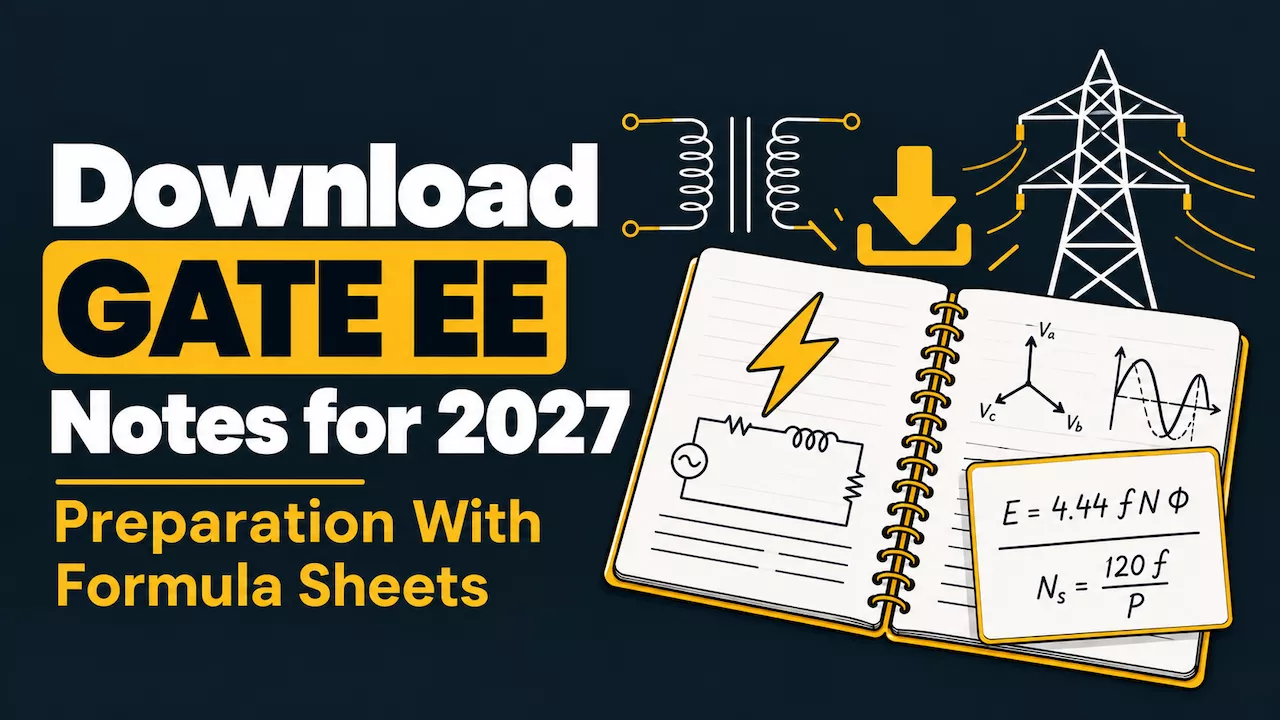
These free GATE EE Notes cover all 10 technical subjects of the Electrical Engineering paper in handwritten PDF form, about 2,500 pages in total. Along with the download links, this page gives you a GATE EE formula sheet for every subject, so you can revise the key formulas without opening each file.
There is also good news for 2027. The GATE EE syllabus 2027 is word for word the same as 2026, so notes written for the current pattern stay fully valid. Our GATE EE syllabus 2027 post confirms this line by line, and the GATE 2027 exam pattern guide explains the marking rules you will practise with.
GATE EE Notes PDF Download: All Subjects in Order of Marks
Most sites list notes in syllabus order. Here, the GATE EE Notes are listed in order of the marks each subject has carried in recent papers, so you can start with what pays most. The last column shows how many days each file takes at a steady 30 handwritten pages a day.
| Subject (GATE EE section) | Average marks, last 3 papers | Pages | Days at 30 pages a day | Download |
|---|---|---|---|---|
| Network Theory (Electric Circuits) | 12.7 together | 258 | 9 | Download |
| Electromagnetic Theory (Electromagnetic Fields) | 155 | 5 | Download | |
| Power Systems | 10.3 | 487 | 16 | Download |
| Power Electronics | 10.3 | 214 | 7 | Download |
| Electrical Machines | 8.7 | 346 | 12 | Download |
| Signals and Systems | 8.3 | 221 | 7 | Download |
| Analog Electronics (Analog and Digital Electronics) | 8.3 together | 277 | 9 | Download |
| Digital Electronics (Analog and Digital Electronics) | 174 | 6 | Download | |
| Control Systems | 8.0 | 191 | 6 | Download |
| Electrical Measurements and Instrumentation | 2.7 | 184 | 6 | Download |
All 10 GATE EE Notes PDF links above were working on 29 October 2026, and every file opens without a login. Each PDF is a scan of handwritten class notes with derivations and solved numericals. Together they are about 510 MB, and Power Systems alone is about 100 MB, so download them on Wi-Fi. Marks are averages from recent papers, not official figures. Reading all 10 files takes about 83 days at 30 pages a day, which fits before the exam if you start in early November.
GATE EE Formula Sheet: Key Formulas From Every Subject
Handwritten GATE EE Notes are great for learning but slow to search, because the pages are images. So here is a compact GATE EE formula sheet that matches the subjects above. Use it after each chapter of your GATE EE Notes and again in the last 2 weeks.
Electric Circuits Formulas
- Maximum power transfer: RL = Rth, and Pmax = Vth2 / 4Rth
- Time constant: τ = RC for an RC circuit and τ = L/R for an RL circuit
- Series RLC resonance: f0 = 1 / (2π√LC), and quality factor Q = (1/R)√(L/C)
- Average AC power: P = Vrms Irms cos φ
Electromagnetic Fields Formulas
- Coulomb’s law: F = Q1Q2 / (4πε0r2)
- Parallel plate capacitor: C = εA/d, and stored energy W = ½CV2
- Faraday’s law: e = −N dΦ/dt
- Inductance: L = NΦ/I, and energy stored in an inductor W = ½LI2
Signals and Systems Formulas
- Sampling: fs ≥ 2fmax to avoid aliasing (Nyquist rate = 2fmax)
- LTI output: y(t) = x(t) * h(t), which becomes Y(s) = X(s)H(s) in the Laplace domain
- Laplace pair: e−atu(t) ↔ 1/(s + a)
- Parseval’s theorem: energy = ∫|x(t)|2dt = (1/2π)∫|X(ω)|2dω
Electrical Machines Formulas
- Transformer EMF: E = 4.44 f N Φm
- Transformer maximum efficiency: when copper loss equals core loss
- Synchronous speed: Ns = 120f/P, and slip s = (Ns − N)/Ns
- Induction motor: rotor copper loss = s × air-gap power
- DC machine EMF: E = PΦNZ / 60A
Power Systems Formulas
- Power transfer over a line: P = (V1V2/X) sin δ
- Per-unit base change: Zpu,new = Zpu,old × (MVAnew/MVAold) × (kVold/kVnew)2
- Surge impedance: Zc = √(L/C), and surge impedance loading SIL = V2/Zc
- Single line-to-ground fault: If = 3E / (Z1 + Z2 + Z0)
Power Electronics Formulas
- Buck converter: Vo = D·Vin
- Boost converter: Vo = Vin/(1 − D)
- Buck-boost converter: Vo = −D·Vin/(1 − D)
- 1-phase fully controlled bridge (continuous current): Vo = (2Vm/π) cos α
- 3-phase fully controlled bridge: Vo = (3VmL/π) cos α, where VmL is the peak line voltage
Control Systems Formulas
- Second-order system: ωd = ωn√(1 − ζ2), and peak time tp = π/ωd
- Peak overshoot: Mp = e−πζ/√(1−ζ²)
- Settling time (2% band): ts = 4/(ζωn)
- Steady-state error: 1/(1 + Kp) for a step, 1/Kv for a ramp and 1/Ka for a parabolic input
Electrical Measurements Formulas
- Ammeter shunt: Rsh = Rm/(m − 1), where m is the multiplying factor
- Voltmeter multiplier: Rse = Rm(m − 1)
- Two-wattmeter method: P = W1 + W2, and tan φ = √3 (W1 − W2)/(W1 + W2)
- Wheatstone bridge balance: R1/R2 = R3/R4
Analog and Digital Electronics Formulas
- Inverting op-amp gain: −Rf/R1; non-inverting gain: 1 + Rf/R1
- BJT: IC = βIB, and β = α/(1 − α)
- An n-bit ADC or DAC has 2n levels
- A mod-N counter needs at least log2N flip-flops, rounded up
This GATE EE formula sheet is a starting point, not the full list. Each subject in your GATE EE Notes has many more results, so add to it as you read, using the method below.
How to Build Your Own 1-Page Formula Sheet From GATE EE Notes
The formula sheet that helps you most in the exam is the one you write yourself. Here is a simple method that works with handwritten GATE EE Notes:
- Keep a separate notebook with 1 page for each of the 10 subjects before you open the first GATE EE Notes PDF.
- While reading, copy every boxed result or underlined formula onto that subject’s page, with the PDF page number next to it.
- After each chapter, solve 5 to 10 previous year questions using only your formula page, not the notes.
- If a question needs a formula that is missing, find it in the notes and add it in a different colour.
- By January, each subject should fit on 1 page. These 10 pages become your main revision material.
The page numbers matter. Since the scanned GATE EE Notes cannot be searched, your formula sheet doubles as an index that takes you straight back to the right page when you need the full derivation.
3 Extra Files You Can Skip for GATE EE
The full set of GATE EE Notes has 13 files, but 3 of them cover subjects that the GATE EE syllabus 2027 does not list. You can skip them for GATE, though they may still help with university exams or other papers:
Communication Systems (112 pages, download) belongs to the EC paper, not EE, and EC students will find it with the rest of our free GATE ECE notes. Electrical Materials (132 pages, download) is not part of the 10 EE sections. Microprocessor (87 pages, download) is also not listed, since the Analog and Digital Electronics section covers logic circuits, converters and timers but not microprocessors.
Leaving these 3 out saves about 330 pages, or 11 days of reading, which is better spent on the core GATE EE Notes for Power Systems or Machines.
What the GATE EE Notes Leave Out
The core GATE EE Notes cover 9 of the 10 technical sections. 2 parts of the paper need other material:
- Engineering Mathematics (13 marks): this set has no maths file, even though maths has carried exactly 13 marks in recent EE papers. Cover linear algebra, calculus, differential equations, complex variables and probability from a standard book. The Engineering Mathematics folder in our free GATE CSE notes has formula guides and probability notes that help with part of this.
- General Aptitude (15 marks): practise it from previous year papers and mock tests, since no subject notes cover it.
Together these 2 parts are worth 28 marks, more than any single core subject, so give them time every day alongside your GATE EE Notes.
The Daily Formula Loop: Revising GATE EE Notes Until February
Reading your GATE EE Notes once is only half the work. Use this daily loop from November until the exam:
- Morning (2 to 3 hours): read 30 pages of the current subject and update its formula page.
- Afternoon (1 to 2 hours): solve previous year questions on what you read, using your formula page.
- Evening (1 hour): Engineering Mathematics or General Aptitude.
- Night (15 minutes): read through the formula sheet above for 1 earlier subject, so nothing is forgotten.
From mid-January, stop reading new pages of your GATE EE Notes and switch to full-length mock tests every 2 to 3 days, revising only from your formula pages. Keep your mock scores well clear of the line: the General cutoff was 27.7 in GATE 2026, as shown in our GATE EE previous year cutoff analysis. To decide subject priorities, see the most scoring subjects for GATE EE 2027, and for a full day-by-day routine, follow the GATE EE 2027 4 months timetable.
FAQs on GATE EE Notes
Where can I download free GATE EE Notes for 2027?
All 10 core subject files are in the download table on this page, listed in order of marks. Each link opens a handwritten PDF on Google Drive that you can save for free without signing up.
Do these GATE EE Notes come with formula sheets?
Yes. This page includes a GATE EE formula sheet with key formulas for 9 subjects, from Electric Circuits to Power Electronics, and a method to build your own 1-page sheet for each subject.
Are the GATE EE Notes valid for the 2027 syllabus?
Yes. The GATE EE syllabus 2027 is the same as 2026 apart from a spelling correction, so notes made for the current pattern remain fully valid.
Which GATE EE Notes should I read first?
Start with Electric Circuits and Electromagnetic Fields, then Power Systems and Power Electronics, since these subjects have carried the most marks in recent EE papers.
Do the GATE EE Notes include Engineering Mathematics?
No. The set has no maths file, although Engineering Mathematics has carried 13 marks in recent EE papers. Use a standard maths book along with previous year questions for it.
Are Communication Systems and Microprocessor part of GATE EE?
No. Neither subject is listed in the GATE EE syllabus 2027, and Electrical Materials is also not included. You can skip these 3 extra files for GATE.
How many pages are the GATE EE Notes?
The 10 core files have about 2,500 handwritten pages and take about 510 MB of storage. At 30 pages a day, you can finish them in about 83 days.
How should I revise GATE EE Notes before the exam?
Make a 1-page formula sheet for each subject while reading, solve previous year questions with it, and from mid-January revise only from those sheets while taking full-length mock tests.